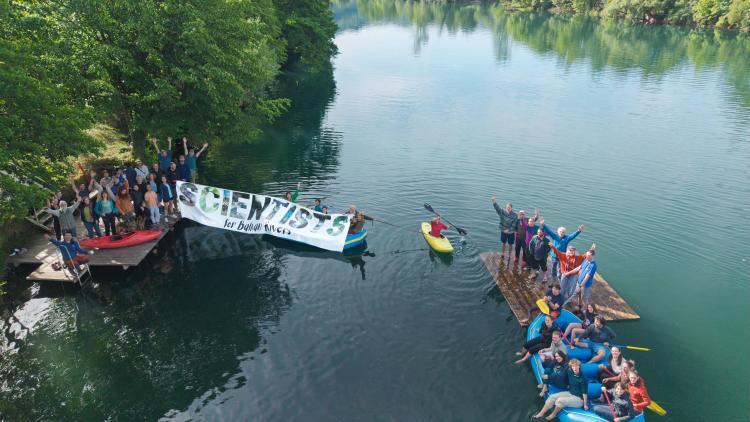
163 experts call for an immediate halt to the hydropower project, citing an extremely flawed Environmental Impact Assessment and widespread irreversible ecological damage.
As we celebrate the third anniversary of the Vjosa Wild River National Park, a study released today warns that the "Wild River" is facing an invisible crisis: massive water abstraction.
More river kilometres have been saved! The Ministry of Spatial Planning, Construction, and Ecology of Republika Srpska has officially rejected the Environmental Impact Study for the proposed Nevačka small hydropower plant in the Bosna Basin in Bosnia and Herzegovina.
The first comparable regional assessment in over a decade documents the deterioration of Europe's last wild rivers, with pristine stretches dropping from 30% to 23% since 2012 - a staggering loss of 2,450 river kilometres. Albania’s rivers have deteriorated faster than those of any other Balkan country, largely due to hydropower and river regulation.
There are things one cannot believe because they are so incomprehensible, so beyond words. Toni Vorauer is dead; he passed away completely unexpectedly after a short illness on November 25. We mourn a friend, a colleague. Toni was a conservationist, someone who dedicated himself especially to rivers and bats.
Today, a coalition of international and Bosnian scientists, together with leading environmental NGOs, reveal evidence linking the mass mortality of fish and other aquatic life on the affected stretch of the upper Neretva on September 12, 2025, to operational practices at the Ulog Hydropower Plant.
Blue Heart partner Polekol has submitted an official letter to the UNESCO World Heritage Centre, warning of escalating pressures that threaten to irreversibly damage one of Serbia's most valuable cultural and natural heritage sites: the Studenica River basin.
In September 2025, Vjosa River was officially recognised as a UNESCO "Man and the Biosphere" (MAB) Reserve, during the World Congress of Biosphere Reserves in China. While it brings international visibility, it also comes with expectations for rigorous follow-up and effective management.
A devastating ecological disaster has struck the upper Neretva River on September 12. Just downstream of the newly built Ulog hydropower plant, local fishermen discovered a 7-kilometer stretch of river filled with dead fish.